
Category Archives: Rainwater Harvesting Education

South Seattle Community Rainwater Collection Seminar


Close-up of a worn, metallic fountain pen nib on a black surface.
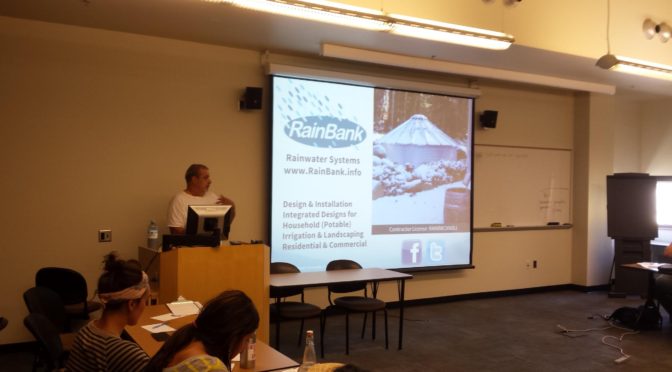
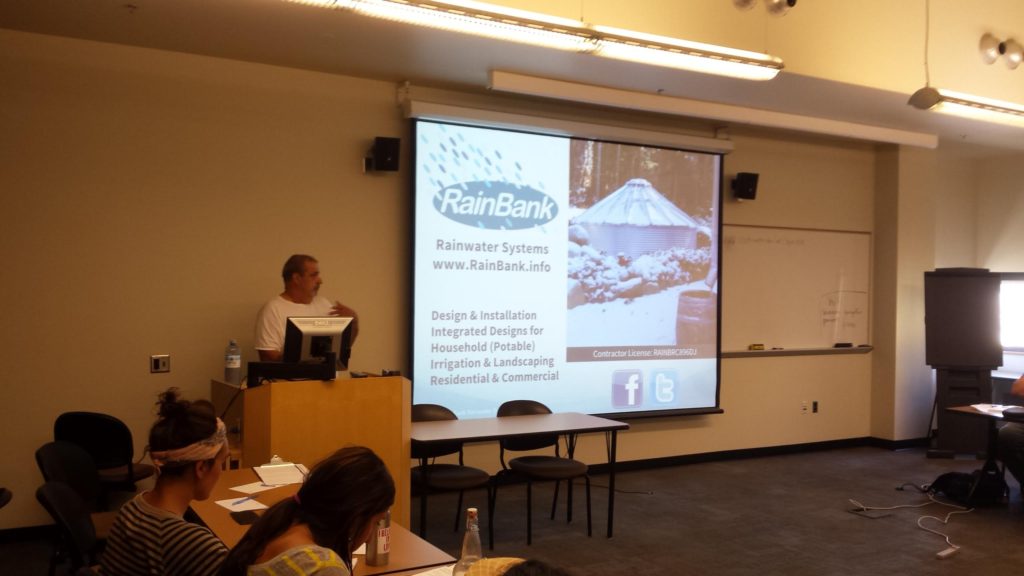
Ken Blair presenting in Seattle

An American Rainwater Catchment Systems Association (ARCSA) lifetime member and ARCSA Northwest Regional Representative, RainBank Rainwater Systems is committed to the education and advancement of best practices of rainwater collection in Washington State. RainBank recently was asked to conduct a seminar at South Seattle Community College for the Green Infrastructure Partnership (GrIP) an active group of landscapers, cistern installers, and Seattle Rainwise program contractors.

GrIPPurpose Statement:

TheGreen Infrastructure Partnershipis a group of nonprofit, government and community-based organizations working with the public to offer solutions to stormwater pollution.Our participantsdo this through education, technical assistance and incentive programs. Our purpose is to increase networking, collaborating and coordinating opportunities for public engagement. Our goal is to bolster voluntary adoption of green infrastructure as a viable, affordable and effective solution to reduce stormwater runoff polluting Puget Sound.

The two hour class included design considerations, implementation, components, and maintenance of systems as well as an introduction to new 2016 code and storm water requirements. An active, open discussion with Seattle community attendees followed the presentation with a question and answer period from the more than 30 participants. An ARCSA Accreditation Workshop in the near future was enthusiastically supported by the audience. RainBank willfollow up with scheduling and registration information . ARCSA is the leader in education of rainwater collection in the US and Canada with most authorities recognizing ARCSA Accredited Professionals as experts in the field.

RainBank Rainwater Systems would like to thank all participants of this latest rainwater collection systems seminar and encourage all participants and other interested parties to help bring the next ARCSA Accredited Professional Work shop to Seattle.
Reinventing Water Supplies – ARCSA Conference 2016


Close-up of a worn, metallic fountain pen nib on a black surface.The theme of ARCSA’s 12th annual conference, set for December in Las Vegas, NV, will highlight reinventing water supplies.
The Mission of the American Rainwater Catchment Systems Association is to promote sustainable rainwater harvesting practices to help solve potable, non-potable, stormwater and energy challenges throughout the world.

The conference and expo will be filled with learning and buying opportunities and will be held at the convention center in conjunction with conferences for the Irrigation and Groundwater Associations.

Visit the ARCSA conference registration page for more information.

RainBank’s leader, Ken Blair, is anaccreditedARCSA Professional, Inspector Specialist, Designer / Installer and Life Member, a PacificCoastal Regional ARCSA representative and advisor to its education committee. Ken is tapped by architects, engineers, government agencies and related professional associationsto provide lectures or participate on expert panels to discuss Rainwater Collection Systems design and builds.

RainBank is also the Northwest region distributorforContain Water Tanks, which are backed with an unmatched20-year warranty.

Sustainability Key Rainwater Harvesting Benefit


Close-up of a worn, metallic fountain pen nib on a black surface.

Colorado needs to look no further than Seattle and Washington State for the sustainability benefits of Rainwater harvesting.

The Colorado rainwater harvesting narrativeshows that as time marches forward, some laws that were passed almost one hundred years ago should be reconsideredbecause they are just no longer practical. Sustainability wasn’t a factorback then, but it sure needs to be part of the equation now.

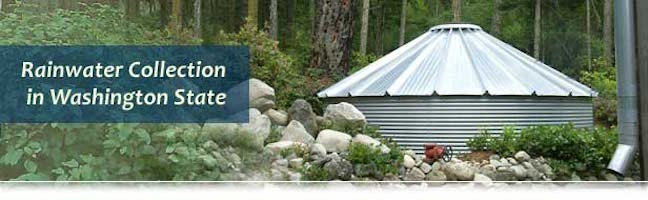
In October 2009–after years of argument–the state of Washingtonofficially declared thatpeople could collect and store rainwater captured from a rooftop or other “guzzler” system without a water right, as long as it is used on site and essentially isn’t hurting anybody else. San Juan County was the only one that allowed rainwater collection and potable use for single family residence as an exemption to the water rights issuebefore the 2009 decision.

Since then, King County recognized thebenefits of rainwater collection in January 2011 for householdusage, with support from State Department of Agriculture. So now, King County Department of Health not only allows, butencourages rainwater collection.

Commercial, private, andcommunities all are findingbenefits to rainwater collection and the positive effects on the environment of the Pacific Northwest and our water supplies. The Washington State Department of Ecology continues to support rainwatercollection and studies the effects of in stream flow rates (Skagit) and salmon habitat.

All Washington State counties allow for rooftop collection for non-potable use, with some allowing for potable use. Non-potable use includes irrigation, toilet facility, laundry,wash down and others that are not intended for consumption or bathing. Commercial applications are directing roof runoff to irrigation and toilet facilities, rather than having this runoff enter our bodies of water withpollutants picked upalong the way.Households are not only using rainwater for non-potable use, but are having systems installed that treat and disinfect therainwater to potable standards that aresuperior to city drinking water, thus conserving water by simply not allowing it to become runoff. Ruralhouseholds are using rainwater collection that benefits aquifers by rainwater collection and household use, through infiltration after use.Communities areorganizing communal gardeningapplying rainwater collection, removing the strain on small water systems, while promoting communityevolvementand education.

We congratulate Colorado on its progress in exploring new (to them) sustainability methods. We welcome Colorado’s steps towards better understanding of thebenefits that we in WashingtonState currently enjoy.