
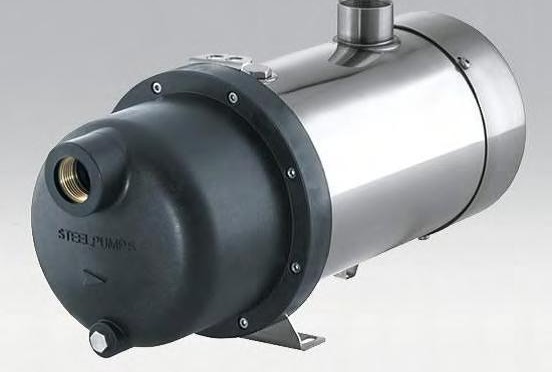
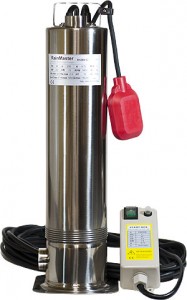
 Either a submersible pump or centrifugal pressure pump will be required to transfer water from storage to filtration and use. A submersible pump will need means of regulating flow.
A pressure tank with a pressure switch will tell the pump when to turn on and off by a drop of pressure in the pressure tank. This application is much like well system and is intended for household use. It could be used for irrigation, but keep in mind that the pressure tank will need to be frost protected.
 The most common method of conveyance would be a booster pump. These pumps are generally centrifugal pumps and can be placed in the mechanical room or well shed. A centrifugal booster pump is used without an exterior pressure tank and is considered an “on demand” pump, meaning that when the faucet is opened, the pressure in the pump drops down to low pressure – usually 20 PSI, and the pump will start running and maintain constant pressure while the faucet is open. Once the faucet is closed, the pump will continue to run until it meets its high pressure cut off.
Either pump system should always be used before filtration and disinfection — which will be our next topic.
Don’t forget to check the box below in order to receive an email notification when blog posts are launched.
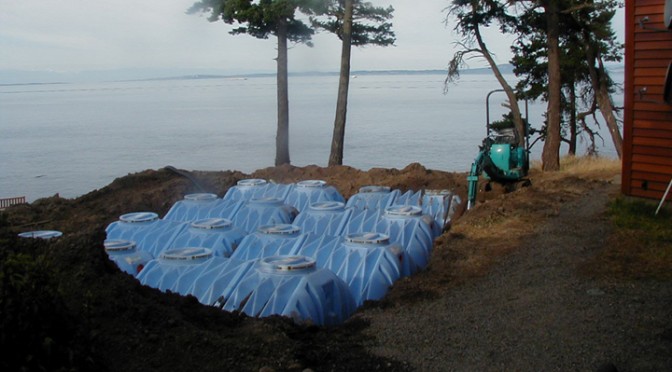
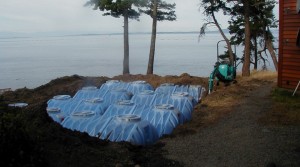 Are you concerned with the aesthetics of above ground water storage? Then underground storage may be right for you.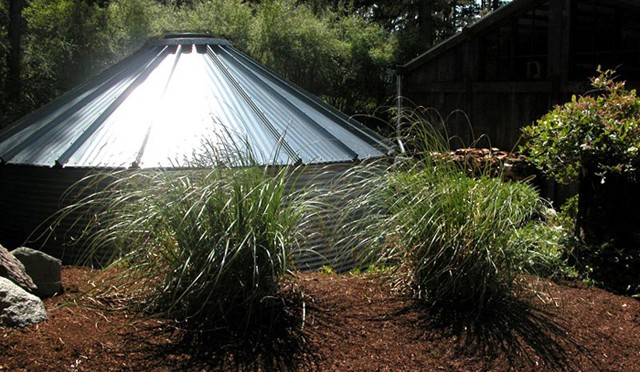
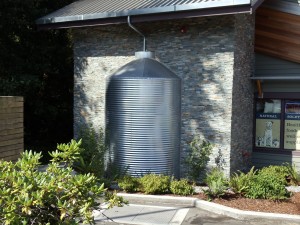 Steel water storage tanks for rainwater collection are generally bolted together grain silos adapted for this use. Made of galvanized corrugated steel panels, wall panels average 17 – 20 gauge with the galvanized roof panels being high rib or flat seam with a center hatch at the top and an access hatch near the bottom of the roof. A felt pre-liner is used between the steel and the main liner to protect it from abrasion. Liners are usually polyethylene and NSF approved when used for potable application or PVC, which is generally used for non-potable. However, PVC can be used for potable, as long as it is NSF approved. RainBank recommends polyethylene for this application.
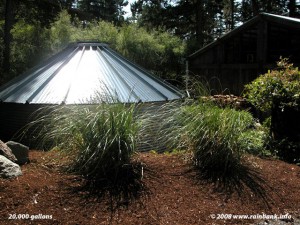 Steel water storage tanks offer durability and protection of the liner from UV rays, plus offers an industrial or rural architectural look. Many commercial applications use this type of storage for both of these reasons. Overflow lines can be installed on the outside of the tank, but it is recommended that any pressurized lines be underground and frost protected in our Washington climate.