Aging Public Water Systems Money Sits Unspent


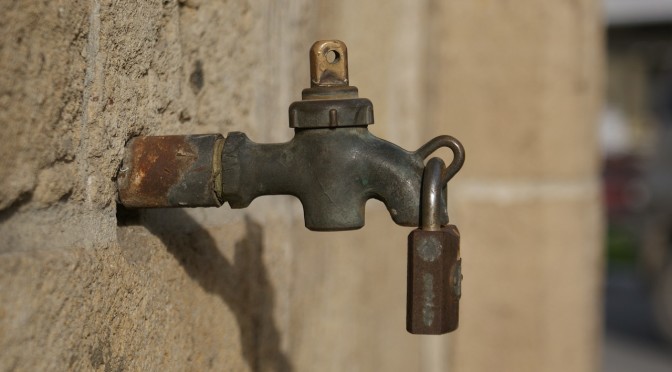
Rusty outdoor faucet secured with a padlock.Water is vital to public health, maintaining our environment and preservation of quality of life. We simply can’t live without water. Our nation’s public water system infrastructure is in dire need of upgrading. Many systems are so old that the maintenance costs are beginning to overtake the cost of replacement.

The EPA offers funding for low interest loans to public water systems. According to a Washington Times article, ‘The U.S. Environmental Protection Agency projects it will cost $384 billion over 20 years just to maintain the nation’s existing drinking water infrastructure. Replacing pipes, treatment plants and other infrastructure, as well as expanding drinking water systems to handle population growth, could cost as much as $1 trillion.”

Furthermore, the article goes on to note that in spite of demand, more than $1 billion sits, unspent, in a funding pool managed by the largest federal aid program for drinking water improvements, the Drinking Water State Revolving Fund, (as reported after a review by The Associated Press).

Why would available funding to improve public water systems, necessary for public health and a strong economy, be left sitting in government accounts? According to CNBC, “Project delays, poor management by some states and structural problems have contributed to nearly $1.1 billion in congressional appropriations sitting unspent in Drinking Water State Revolving Fund accounts as of Aug. 1.”

Adding to the muck, the money that is being tapped is largely used for services associated to drinking water, but not infrastructure improvements. The CNBC article goes on to report “About 1 in 5 dollars in recent years has gone to purposes such as paying the salaries of state employees and contractors. Those expenses are allowable but leave less for the repair and replacement of leaky pipes, deteriorating treatment plants and century-old storage tanks.”

So, while funding is available for municipal and county water systems improvement, almost 20 percent of the money drawn from this grant pool is currently being used to pay for administrative costs, leaving less money available for the $1 trillion estimated that will be needed across the board – for just water infrastructure improvements, not inclusive of roads, bridges, energy, etc.

There are many safe and sustainable options available to supplement public water systems with rainwater collection. While available in many areas, we need more education about the value and stability achieved by adding a rainwater collection system to a residence or commercial property. In some areas, a rainwater collection system could be sole-source for whole house usage, or a supplement to city water, easing the burden on public systems caused by population growth and aging infrastructure.
Our World’s Water Supply is Limited


A small globe inside a clear water droplet on a textured surface.Do you know that up to 60% of the human adult body is water?

According to H.H. Mitchell, Journal of Biological Chemistry, the brain and heart are composed of 73% water, and lungs are about 83%. The skin contains 64% water while muscles and kidneys are 79%. Even bones are a watery 31%.

With that said, here are some important facts about current limited global water availability:

  • 783 million people do not have access to clean drinking water
  • One half of the world’s hospital beds are filled with people suffering from water borne disease.
  • 64% of households throughout the world rely on women to get the family’s water when there is no water source at home.
  • Globally we use 70% of our water sources for irrigation and only 10% for domestic use.

Water is a limited resource; it is not infinite. What each of us does in the world and how we live affects our water supply. Wecan make a difference. We can take steps globally to protect our water resources by simple conservation techniques.

A child dances energetically while a group plays drums and claps outdoors.Education is the key to protecting the water supply in developing countries and industrial countries as well. Non-profit organizations such as Bank on Rain are spreading the word about rainwater collection and teaching conservation techniques to those who do not have a clean source of drinking water.

Man giving a presentation to an audience in a conference room.
Ken Blair, AP, IS, presenting educational seminar about rainwater collection. Do you know that up to 60% of the human adult body is water?

Ken Blair, president of RainBank Rainwater Systems is a lifetime member of ARCSA. The Mission of the American Rainwater Catchment Systems Association is to promote sustainable rainwater harvesting practices to help solve potable,non-potable, stormwater andenergy challenges throughout the world.

Ken has also achieved the status of Accredited Professional, Systems Inspector, and is ARCSA’s Northwest Regional Representative.

Water Districts Must Adopt Potable Rainwater Collection


Rusty outdoor water faucet with water flowing from it.Even with the currentdrought, some water districts, municipalities and counties in Washington are still noton board with collection of rainwater for potable usage.

With the newly released water supply predictions from Seattle Public Utilities stating that a 30% reduction in available water within the next 35 years is likely, counties and municipalities in Washington State that do not currently allow for potable use of collected rainwater should reconsider this position.

Both Pierce and Snohomish County water districtshave yet to allow rainwater collection for potable usage for residential use. The cities of Bellevue and Sammamish, even though part of King County, which for several years hasallowed rainwater harvesting for potable use, continue to refuse rainwater collection as a potable source of water for a single-family residence. Both county’s water districts, along with Seattle Public Utilities are part of television advertising campaign asking customers to take shorter showers and only do full loads of laundry and dishwashing.

Is this their solution to the growing problem of water availability? I recently met with the water district in Pierce County at Pacific Lutheran University about a possible project for sustainability including rainwater collection for a dwelling on campus, to be used as an example of potable use. The purpose was for students to gain experience about rainwater harvesting in a real life .A representative of the water district told us it would never happen as long as he was in charge.

I recently represented a customer in Sammamish who was pursuing rainwater collection for non-potable use (toilet and laundry facility) for five new single family residences and was met with significant opposition by city officials. Multiple meetings with the city resulted in the customer giving up his pursuit. Instead, the houses will be totally dependent on the city water supply.

Snohomish County’s smaller water districts have resorted to purchasing water from the city of Everett during this drought because of their water supply running extremely low this summer. But yet, the county still takes the stance of not allowing residential potable usage of collected rainfall. What we’re talking about is rain that could be collected during rain events to help supplement a burdened city water supply.

Most counties in Eastern Washington, even though extremely affected by the drought, have yet to adopt rainwater collection for potable use.

It is time for these districts to become educated in the benefits of rainwater collection and allow customers to become their own purveyors of their own water. To be held hostage by the water districts because of revenues is not only wrong, but it also intensifies the water shortage issues we have experienced and will continue to experience.

Rainwater Systems