Would You Buy Genetically Modified Salmon?


Close-up of a worn, metallic fountain pen nib on a black surface.
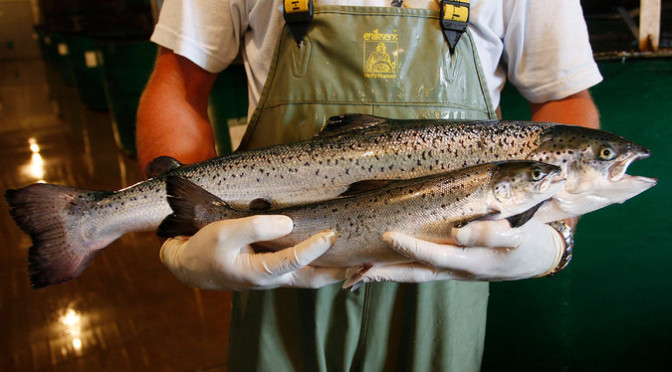
A genetically engineered salmon from AquaBounty Technologies, rear, with a conventionally raised sibling roughly the same age. Credit Paul Darrow for The New York Times

The US Food and Drug Administration recently gave the green light to genetically modified salmon, deeming it safe for consumption. This landmark decision makes salmon the first genetically altered animal to be approved for US groceries and, ultimately, our homes. This strain of salmon’s DNA has been altered to make it grow faster, creating a market sized end product that also requires less feed to reach maturity.

According to the Wall Street Journal, consumers may be hard pressed to find the GMO salmon in groceries, as many have pledged to not carry any GMO foods.

The article further states: “Andrew Kimbrell, the Center for Food Safety’s executive director, said that if the modified salmon find their way into open waters, their rapid growth could allow them to outcompete wild Atlantic salmon and become preferred mates, putting the wild species at risk of being replaced with AquaBounty’s version. ‘If even a small amount would escape, that would threaten native populations,’ said Mr. Kimbrell, whose group plans to sue in federal court by the end of the year.”

Will You Know You’re Buying Genetically Modified Salmon?

According to a NY Times article, the FDA reports that the fish would not have to be labeled as genetically engineered, “however, it issued draft guidance as to wording that companies could use to voluntarily label the salmon as genetically engineered or to label other salmon as not genetically engineered.”

We’d love to hear your thoughts about how we can spend more time and energy preserving our natural resources, or, on the other hand, share your comments if you think the future looks brighter with even more genetically modified foods for our diets.
The WISY 4 Step Rainwater Collection System


Close-up of a worn, metallic fountain pen nib on a black surface.Earlier this year, we announced that we are a WISY product dealer.

A rainwater system designed with WISY products requires minimal maintenance and never needs replacing. With the WISY 4 Step system, you’ll never clean a filter basket or a tank again. Ever.

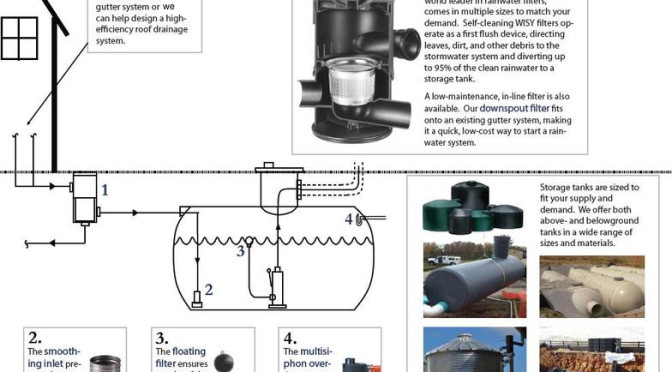
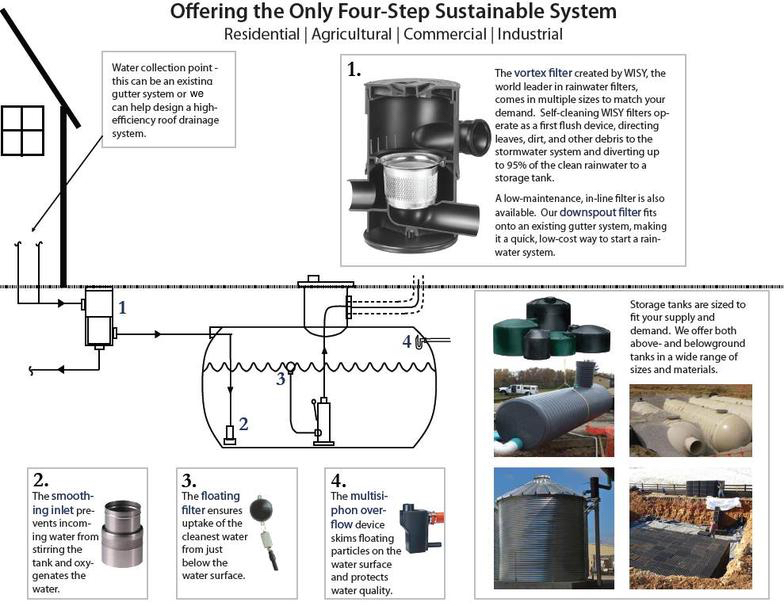
The WISY 4 step system.

Step 1. WISY VORTEX FILTER

Before entering the tank for storage, rainwater should be both filtered and aerated. Filtration removes large particulate matter, which frequently both carries and feeds bacteria. Removal of this particulate matter, along with oxygenation of the water, greatly reduces the amount of harmful bacteria in the tank. WISY pre-tank filters accomplish both of these tasks, protecting the water quality in the tank.

Step 2. WISY SMOOTHING INLET

While filtration removes most of the sediment and bacteria before rainwater enters the tank, a small quantity will settle at the bottom of the tank. This biofilm layer is beneficial for the tank and may remove additional bacteria and metals from the water. The WISY smoothing inlet calms rainwater as it enters the storage tank to prevent the agitation of sediment at the rainwater inlet. The smoothing inlet also helps aerate harvested rainwater by directing water upward and outward, avoiding disruption of the beneficial biofilm layer and preserving water quality in the tank.

Step 3. WISY FLOATING FILTER

Since all harvested rainwater is filtered before entering the tank, the floating filter should never clog but will instead take water from just below the surface. Water at this depth is of the highest quality in the tank, because any particulate that enters the tank either floats on the surface or settles to the bottom. In RainBank designed systems, the floating filter acts more as an uptake point for the pump than a filter; thus, the floating filter should never require maintenance.

The floating filter consists of a polyethylene ball and stainless steel filter and is supplied with a standard 7 foot length of food-grade suction hose. The nozzle connections are available in 1 1/4″ and 2″ sizes.

Step 4. WISY OVERFLOW DEVICE

To prevent backup in the system during heavy rains, the storage tank should always include an overflow protection device. The WISY overflow device has a flapper valve, which allows water to overflow but protects water quality in the cistern with backflow prevention and vermin protection. The overflow device also contains an angled opening to provide skimming of small buoyant debris, such as pollen, on the water surface.

More to come:we will offer an onlineshopping cart for you to make your purchases. Contact us with questions about the WISY 4 Step System.

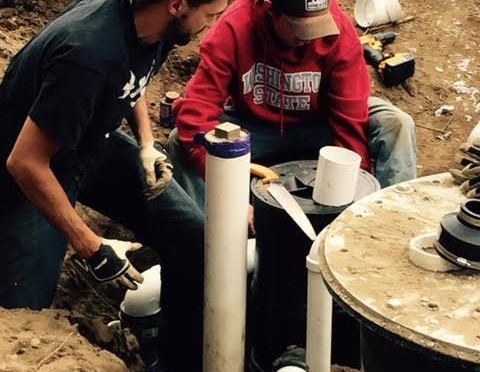
Proper Installation is Key for Rainwater Collection System


Close-up of a worn, metallic fountain pen nib on a black surface.Rainwater collection systems can be a simple as rain barrels or as complicated as whole house potable usage. Still, proper installation is imperative.

Even with the simplest design, like a rain barrel garden system, proper installation is the key to a successful system.

Screening the roof runoff before it enters your storage is essential for water quality. Organic matter entering your storage will decompose and add an odor and possible discoloration of your water. A simple downspout screen upstream of your storage should suffice for small non-potable systems. For household use systems, gutter screening, so debris does not enter downspouts and conveyance lines, achieves best results. This should be followed by prescreening or filtering for smaller particulate, which can be accomplished by a screen basket placed in a sump on top of cistern. All screening requires inspections and cleaning as needed. A vortex filter is a device that replaces a sump or tank screen, which requires less maintenance and cleaning. These devices are available in downspout application, replacing downspout screens, as well as larger vortex filters that are generally installed before cisterns or sump boxes.

Water that is drawn from the cisterns to pressurization, filtration and use is best taken from mid level in the cistern. This can be accomplished with floating suction. Water in the mid water column is the cleanest water in the cistern. Any particulate in the storage tank is either floating on the surface or sinks to the bottom. In addition, if water entering the cistern is aerated and sent out horizontally, it will not disturb the sediment at the bottom of the tank. The aeration of the water will help keep bacteria to lower levels.

Tight line from downspouts to sumps or cisterns should have a drop of 1/16″ per ft. so as to keep standing water in the pipe. The same holds true for gutters. Standing water, if not aerated and free of particulate, can begin to go sour and not only create more bacteria, but can cause an unpleasant odor. Therefore, conveyance lines should be kept away from direct sunlight, have a gentle slope, and kept clean of organic matter. This may cause more work during installation, but is well worth the time and money to do so.

Wisy products, including a vortex filter, calming device, floating suction, and overflow device will keep your water clean and particulate free for storage. Routing your conveyance lines so they are kept from UV light, sloped, with no bends greater than 45 degrees will help water entering your cisterns as clean as can be with the end use being cleaner safe water, whether it is for potable or non potable.

RainBank is a Wisy product distributor. Contact us using the form below to purchase Wisy products.

Go back

Your message has been sent

Warning
Warning
Warning
Warning

Warning.

Rainwater Systems