
Good News For Washington Drought Watchers


Close-up of a worn, metallic fountain pen nib on a black surface.The drought that hit Washington state in 2015 has been nearly eradicated due to heavy rains and snow to ring in 2016. According to the theU.S. Drought Monitor, the south-east corner of the state is still in moderate drought, but with a high percentage of Washington’s water supply coming fromsnowpack accumulationsand which statewide are more than 100 percent of normal for this time of year, most Washingtonians are sitting pretty when it comes to water supplies since forecasts for the April-September runoff period are within the normal range.

What does this mean for the future of water conservation in Washington state?

According to its website, “The Water Supply Availability Committee (WSAC) will continue to meet in 2016 to evaluate current and forecasted water supply conditions and to consider whether drought conditions are likely to be in effect spring and summer. This web page is provided to track the meeting information for this group.

The 2015 statewide drought declaration expired December 31, 2015. Forecasts for January thru March 2016 are for warmer, drier conditions as a result of El Niño.Ecology will continue to evaluate conditions and monitor water supplies.”

What does this mean for folks who use water in Washington state?

RainBank had a busy first quarter designing and installing rainwater collection systems in the Puget Sound area and Portland, OR. These were projects where residents and businesses wanted to capture the ElNiño driven rains for drinking, irrigation, toilet and/or laundry facilities. Some will use their systems to supplement well or city water, while others are able to go completely off-grid and use rainwater to supply all of their needs.

We don’t have to wait for drought to set our conservation plans in motion. Be proactive and contact RainBank today to learn how you can include rainwater harvesting in your new construction or remodeling project. We work closely with general contractors and architects to design and construct the most efficient, well-constructed system you can find anywhere in the country. We stand by our systems, many of which are still operating after 15 years.
Flint Opens Floodgates for Testing Water Quality


Close-up of a worn, metallic fountain pen nib on a black surface.
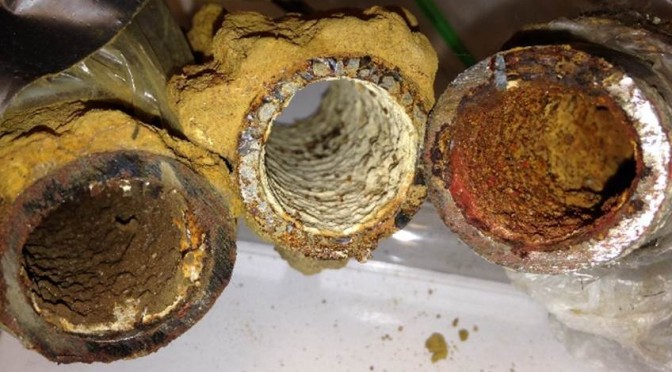
Exemplary pictures looking into Flint drinking water pipes, showing different kinds of iron corrosion and rust (Photo: Min Tang and Kelsey Pieper) http://flintwaterstudy.org/tag/drinking-water/

We at RainBank have been writing about declining water quality in public systems in the United States since we started sharing information in 2014. Aging infrastructure is an issue that has been known for quite a long time, but only recently has beenbrought to greater awareness because of the Flint lead poisoning crisis. Older public water systems are typically comprised of galvanized pipe and can be 70 or more years old. This issue of contaminated water is not new, but has been building over many years and is becoming more widely known because more testing is being performed.

A recent article in USA Today, Beyond Flint: Excessive lead levels found in almost 2,000 water systems across all 50 states, the jarring results of an independent study found that of water systems tested,lead levels beyond EPA standards were found. Overall, these systems provide water to 6 million people, a percentage of which supply drinking water to facilities where children gather or reside – and where some of the highest levels were found. Additionally, some didn’t even notify the public.

Coast to coast, water quality awareness is being raised and tests are being performed. At NJ.com, it was reported that a hospital in Morristown, NJ recently learned of rising lead levels in its water supply, reporting, Twenty-eight out of 39 samples tested by the hospital on Feb. 22 were above the federal Environmental Protection Agency’s action limit of 15 parts per billion…” Also in Newark, NJ, the largest city in the state, the school system is testing students for lead because, not only was it discovered the levels were high, but it has been known for years – and not reported. (Read more from The NY Times Newark Schools to Test Pupils for Lead as Officials Cite Longstanding Problem)

The EPA and the Centers for Disease Control and Prevention (CDC) agree that there is no known safe level of lead in a child’s blood. Lead is harmful to health, especially for children.

And it’s not just lead. In the Puget Sound, drugs were found in salmon from fouled wastewater. “Prozac, Advil, Benadryl, Lipitor, even cocaine. Those drugs and dozens of others are showing up in the tissues of juvenile chinook, researchers have found, thanks to tainted wastewater discharge.” Additionally, common over the counter pharmaceuticals like Flonase, Aleve and Tylenol were present, along with Paxil, Valium and Zoloft, Tagamet, OxyContin and Darvon. Nicotine and caffeine, fungicides, antiseptics and anticoagulants and Cipro and other antibiotics – were also included in this toxic mix. According to the Seattle Times, “the findings are of concern because most of the chemicals detected are not monitored or regulated in wastewater, and there is little or no established science on the environmental toxicity for the vast majority of the compounds detected.”

Of course, we believe the best solution is rainwater collection. Water harvested from roof runoff is relatively clean and can be used to bypass or supplement city or well water. It has commercial and residential applications that run from drinking to irrigation, toilet flushing, vehicle wash down and more. Contact us for more information.

Rainwater Saves Money in Seattle


Close-up of a worn, metallic fountain pen nib on a black surface.According to a press release issued by Drexel’s College of Engineering, “research by a team of Drexel University environmental engineers indicates that it rains enough in Philadelphia, New York, Seattle and Chicago that if homeowners had a way to collect and store the rain falling on their roofs, they could flush their toilets often without having to use a drop of municipal water.”

Franco Montalto, P.E., PhD, an associate professor in Drexel’sCollege of Engineering, and director of itsSustainable Water Resource Engineering Lab states,”Philadelphia and Seattle are the two cities where percent water savings would be greatest if residential neighborhoods were all equipped with rainwater harvesting systems.”

RainBank Rainwater Systems has been designing and constructing systems throughout the Pacific Northwest for more than15 years. Many of our Seattle customers have included rainwater collection as part of new residential construction and retrofitted existing homes. Toilet flushing, laundry facility, and irrigation can all be supplied with non potable rainwater. Whole house usage or potable water can be achieved with proper filtration and disinfection as well.

You don’t need a lot of storage to save money. RainBank Rainwater Systems has designed and installed 3,000 gallon systems that supply an average 2,000 sq. ft. home with 60% of its household use, simply because of the amount of fall and winter rainfall.

Read more from Drexel University Engineering: Here’s Why We Should Use Rainwater to Flush Toilets

Rainwater Systems