
 Even with the currentdrought, some water districts, municipalities and counties in Washington are still noton board with collection of rainwater for potable usage.
With the newly released water supply predictions from Seattle Public Utilities stating that a 30% reduction in available water within the next 35 years is likely, counties and municipalities in Washington State that do not currently allow for potable use of collected rainwater should reconsider this position.
Both Pierce and Snohomish County water districtshave yet to allow rainwater collection for potable usage for residential use. The cities of Bellevue and Sammamish, even though part of King County, which for several years hasallowed rainwater harvesting for potable use, continue to refuse rainwater collection as a potable source of water for a single-family residence. Both county’s water districts, along with Seattle Public Utilities are part of television advertising campaign asking customers to take shorter showers and only do full loads of laundry and dishwashing.
Is this their solution to the growing problem of water availability? I recently met with the water district in Pierce County at Pacific Lutheran University about a possible project for sustainability including rainwater collection for a dwelling on campus, to be used as an example of potable use. The purpose was for students to gain experience about rainwater harvesting in a real life .A representative of the water district told us it would never happen as long as he was in charge.
I recently represented a customer in Sammamish who was pursuing rainwater collection for non-potable use (toilet and laundry facility) for five new single family residences and was met with significant opposition by city officials. Multiple meetings with the city resulted in the customer giving up his pursuit. Instead, the houses will be totally dependent on the city water supply.
Snohomish County’s smaller water districts have resorted to purchasing water from the city of Everett during this drought because of their water supply running extremely low this summer. But yet, the county still takes the stance of not allowing residential potable usage of collected rainfall. What we’re talking about is rain that could be collected during rain events to help supplement a burdened city water supply.
Most counties in Eastern Washington, even though extremely affected by the drought, have yet to adopt rainwater collection for potable use.
It is time for these districts to become educated in the benefits of rainwater collection and allow customers to become their own purveyors of their own water. To be held hostage by the water districts because of revenues is not only wrong, but it also intensifies the water shortage issues we have experienced and will continue to experience.
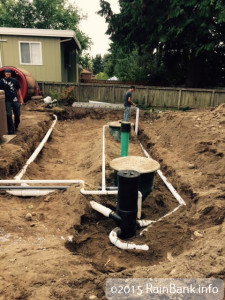 Buried tanks have less visual impact than that of above ground tanks. Careful planning and engineering is required for this type of installation. Care must be given to surrounding vegetation and tree root systems. Grading and drainage requirements must be met so impact is reduced.
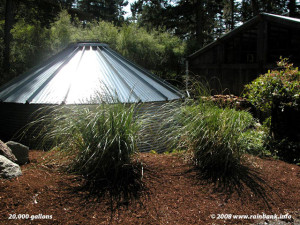 Steel tanks generally can have increased volume and are usually constructed in more of a rural environment. Steel tanks require an engineered slab and must meet seismic requirements. Many find that the industrial look is aesthetically pleasing.
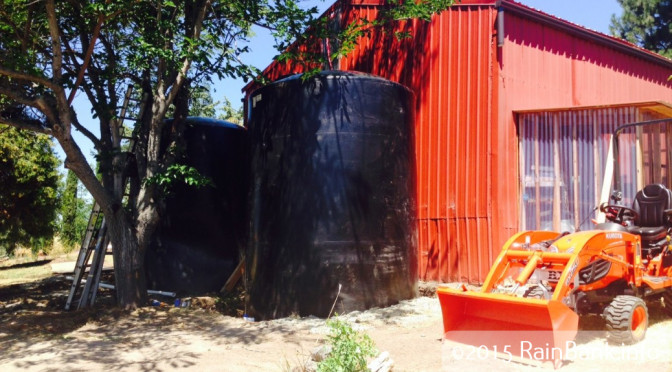
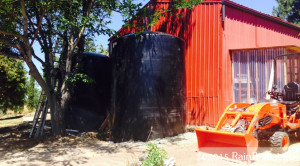 Plastic tanks (top and right) are the most cost effective and come in many sizes from 50 gallons to 10,000 gallons. Multiple tanks can be manifolded together. While most are guaranteed for UV protection, shading from the sun will increase longevity of the tank.
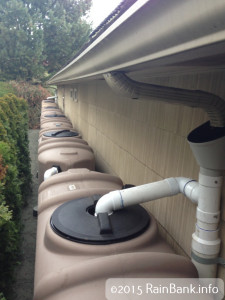 Slimline tanks offer a compact install for the urban customer, requiring little area for storage. They can be connected together to increase volume.
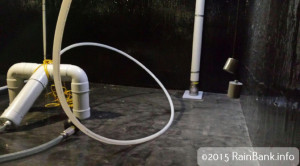 And finally, cement vault storage under the dwelling can be achieved with proper engineering. This type of storage allows a large volume with no visual impact or area used up for the cistern other than below the structure itself. Care must be given structurally, as well as moisture and condensation concerns need to addressed.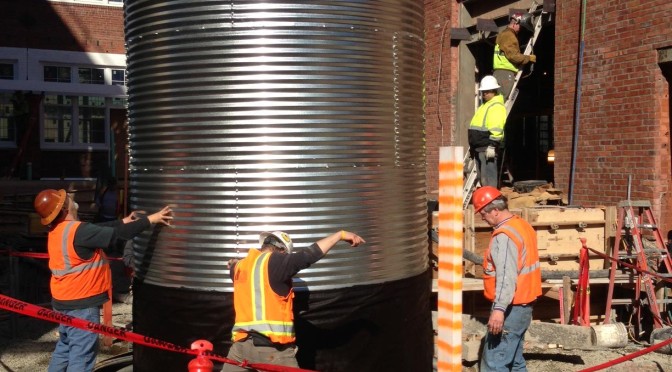
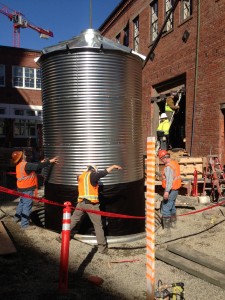 With 15 years of experience in the rainwater collection industry, RainBank has assembled a photo galleryof some of the steel tank installations we’ve completed.