
 Water is vital to public health, maintaining our environment and preservation of quality of life. We simply can’t live without water. Our nation’s public water system infrastructure is in dire need of upgrading. Many systems are so old that the maintenance costs are beginning to overtake the cost of replacement.
The EPA offers funding for low interest loans to public water systems. According to a Washington Times article, ‘The U.S. Environmental Protection Agency projects it will cost $384 billion over 20 years just to maintain the nation’s existing drinking water infrastructure. Replacing pipes, treatment plants and other infrastructure, as well as expanding drinking water systems to handle population growth, could cost as much as $1 trillion.”
Furthermore, the article goes on to note that in spite of demand, more than $1 billion sits, unspent, in a funding pool managed by the largest federal aid program for drinking water improvements, the Drinking Water State Revolving Fund, (as reported after a review by The Associated Press).
Why would available funding to improve public water systems, necessary for public health and a strong economy, be left sitting in government accounts? According to CNBC, “Project delays, poor management by some states and structural problems have contributed to nearly $1.1 billion in congressional appropriations sitting unspent in Drinking Water State Revolving Fund accounts as of Aug. 1.”
Adding to the muck, the money that is being tapped is largely used for services associated to drinking water, but not infrastructure improvements. The CNBC article goes on to report “About 1 in 5 dollars in recent years has gone to purposes such as paying the salaries of state employees and contractors. Those expenses are allowable but leave less for the repair and replacement of leaky pipes, deteriorating treatment plants and century-old storage tanks.”
So, while funding is available for municipal and county water systems improvement, almost 20 percent of the money drawn from this grant pool is currently being used to pay for administrative costs, leaving less money available for the $1 trillion estimated that will be needed across the board – for just water infrastructure improvements, not inclusive of roads, bridges, energy, etc.
There are many safe and sustainable options available to supplement public water systems with rainwater collection. While available in many areas, we need more education about the value and stability achieved by adding a rainwater collection system to a residence or commercial property. In some areas, a rainwater collection system could be sole-source for whole house usage, or a supplement to city water, easing the burden on public systems caused by population growth and aging infrastructure.

 Do you know that up to 60% of the human adult body is water?
 Education is the key to protecting the water supply in developing countries and industrial countries as well. Non-profit organizations such as
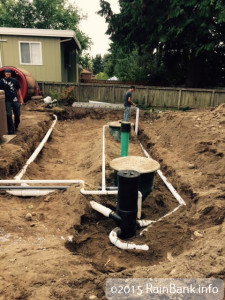 Buried tanks have less visual impact than that of above ground tanks. Careful planning and engineering is required for this type of installation. Care must be given to surrounding vegetation and tree root systems. Grading and drainage requirements must be met so impact is reduced.
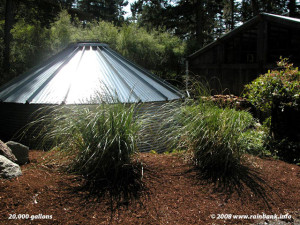 Steel tanks generally can have increased volume and are usually constructed in more of a rural environment. Steel tanks require an engineered slab and must meet seismic requirements. Many find that the industrial look is aesthetically pleasing.
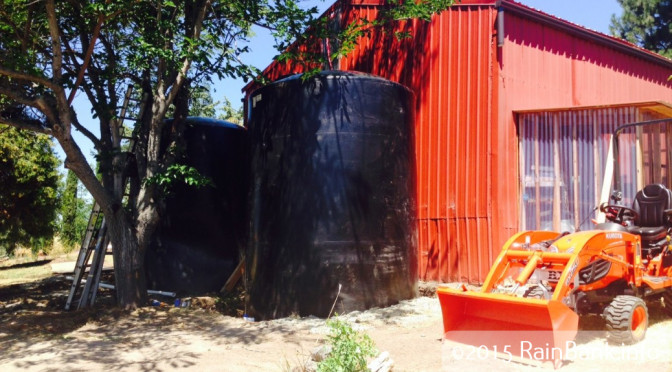
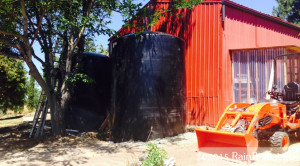 Plastic tanks (top and right) are the most cost effective and come in many sizes from 50 gallons to 10,000 gallons. Multiple tanks can be manifolded together. While most are guaranteed for UV protection, shading from the sun will increase longevity of the tank.
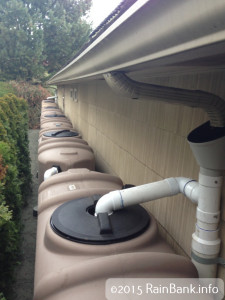 Slimline tanks offer a compact install for the urban customer, requiring little area for storage. They can be connected together to increase volume.
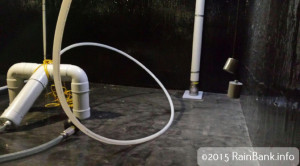 And finally, cement vault storage under the dwelling can be achieved with proper engineering. This type of storage allows a large volume with no visual impact or area used up for the cistern other than below the structure itself. Care must be given structurally, as well as moisture and condensation concerns need to addressed.