All posts by Ken Blair

A rainwater collection systems designer and consultant, Ken has designed and installed residential and commercial systems, primarily in the northwest United States for more than 10 years and, in 2014, began consulting and managing builds in other states. Ken is an accredited ARCSA Professional Designer / Installer and Life Member, the Northwest Regional ARCSA representative and advisor to its education committee and is available to speak about Rainwater Collection Systems design and builds. Ken is a United States Navy veteran, having served on active duty during the Vietnam War era. A career entrepreneur, Ken created a new business focus with a commercial dive company in Hawaii in the mid 1980′s to respond to and clean up oil spills, oil spill equipment training, service and maintenance for the oil co-op service industry. Ken is passionate about having a positive impact on the environment and is also a founding director of BANK-ON-RAIN (2011-2014), whose mission is to create grassroots solutions for rainwater collection for consumption and agriculture in developing areas of the planet.

Designing a Residential Rainwater Collection System for Irrigation


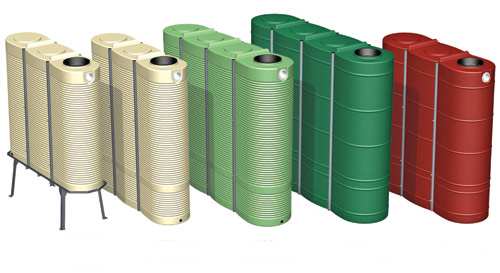
Various sizes of green and beige water storage tanks.We recently discussed key factors in designing a rainwater collection system and briefly discussed intended uses such as irrigation, toilet and laundry facility, and whole house usage including potable.Let’s take a look at designing a residential rainwater collectionsystem for irrigation based on storage capacity.

For ruralapplications with more available space for storage, this can be achieved with large tanks. However in an urbansetting where space is limited, the designer must take into consideration not only the planting area, but also available space for storage.

Most horticulturists will say that for the healthy growth of plants, one inch of rainfall per week is required. If one square foot ofsurface area receives .623 gallons per inch of rainfall, we can size usage and equate that to storage needed.

For example: 200 sq ft of planting area requires 124.6 gallons per week for irrigation or 1495.2 gallons stored for 12 weeks of dry season.

Now let’s look at space required forstorage of 1495.2 gallons. Considering 7.48 gallons per cu ft,1495.2 gallons = 199.89 cu ft.
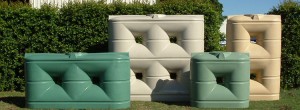
Stacked green and white modular blocks outdoors on grass.Sizes and dimensions very from each manufacturer and most manufacturersoffer cylindrical and slim line style tanks. Slim line designs are better suited for tight areas along side the house. While box tanks with their low profiles are best suited for under decks. A cylindrical tank needs some space, but offersthe most bang for your buck with higher storage capacities, requiring fewertanks for larger storage needs.

Sizing your storage for 3 months of dry season, like we experience in the Seattle area, is dependent on area of planting and available space for storage. Both need to be considered for a successful design.

Take The WaterSense Quiz


Screenshot of "Test Your Water Sense" game menu with options and a water droplet mascot.In Seattle, we are not facing a water shortage. Here at RainBank, we take aging water systems, water usage, storageand rainwater collection seriously. But, that doesn’t mean we can’t have some fun while being mindful about water.

Who hasn’ttriedthefun quizzes on Buzzfeed– like “How Many US States Have You Visited?” or “How Well Do You Know the Solar System?”

The EPA has joined the quiz frenzy with a WaterSense Quiz, a fun game to test your knowledge and share some facts aboutwater.

The object of the game is to move the water-efficiency hero, aptly namedFlo,through water pipes and answer water-efficiency questions while avoiding water-wasting monsters such asSogosaurusandDrainiac.

It may seem like child’s play, but if you try the EPA’s new interactive online quiz, you’ll be sure to learn a few factsabout water usage.

Click here to playthe game(Editor’s note – this version may not be mobile friendly), or click here to view a text only version of the quiz.Take yourturn and leave us a comment to let us know how you scored!

Can Rainwater Collection Control Stormwater Issues in WA?


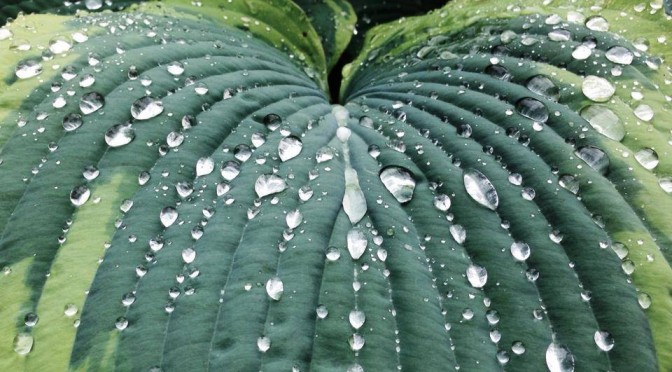
Water droplets resting on a green leaf with prominent veins.
Photo courtesy of danschenker.com
Is promotion ofrainwater collection an opportunity for counties in Washington State to control stormwater?

As of October 2009, rainwater collection is legal in all counties in Washington State. Many county Health Departments are allowing collected rainwater for potable use as well. King County, the largest county in the state, allows for potable usage. Seattle Public Utilities offers rebates for rain gardens in certain areas of Seattle such as Ballard. The Rainwise Program encourages home owners to collect and use roof runoff to help control storm water. Many consumers have taken advantage of this program and are practicing good storm water control. The GSI or “green storm water infrastructure“mandate addresses the issue of storm water runoff for new construction by total infiltration of impervious surfaces on site.

But what about all the existing buildings and houses throughout our state including Seattle area, wherestormwaterrunoff still overwhelms sewer systems, causing intentional sewage release into the Puget Sound during large rain events?

What can the counties and municipalities do to encourage existing building and home owners to control their runoff, thus reducing or eliminating these large releases? Public awareness is an excellent start. Countyand municipality funded educationusing media andpublicservice announcements promoting rainwater catchment practices while offering incentives such as theRainwise program would generate interest. A properly funded program of encouragement and incentives would create morepublicinterest to adopt rainwater collection, as it has with the Rainwise Program, while money being spent to promote would be absorbed by the cost savings totheoverwhelmed systems we experience now.

Rainfall collection and use can be part of thesolution to Seattle’s storm water issue, augmenting the GSI mandate by addressing runoff, not only from new construction, but from existing buildings and homes as well. It’s fair to saythat most Seattleites would welcome being part of the solution — if given the opportunity.