

 Seattle based RainBank Rainwater Collection Systems to attend ARCSA conference addressing U.S. Water Supply Challenges.
This year marksARCSA‘s20th anniversary, and its annual conference will put the focus on Rainwater Harvesting: Solutions to U.S. Water Supply Challenges.
The annual rainwater collectionconference, to be held in Phoenix, AZ this November, will offer presentations from educators, industry professionals, and keynote speakers, with topics includinglegislative action, codes and standards, guidelines, along with panel discussions, and workshops centered around rainwater collection.
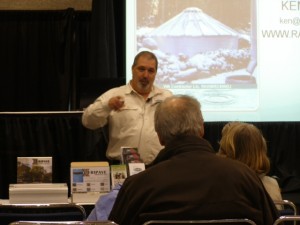 RainBank’s president Ken Blair was tapped topresenta session onUrban Rainwater Collectionand its effects on stormwater runoff mitigation.
Additionally, Ken will participate inan advanced continuing education course to attain the designation of Inspection Specialist (IS), augmentinghis already achieved,Accredited Professional (AP) qualification and lifetime member status.
Adding theIS accreditation to itslistof qualifications solidly identifiesRainBank as theleader in rainwater catchment systems design and installation for commercial and residential customers, especially forSeattle area customers and classifiesRainBank asthe most qualified, up to date, professional Rainwater Collection company in the industry.
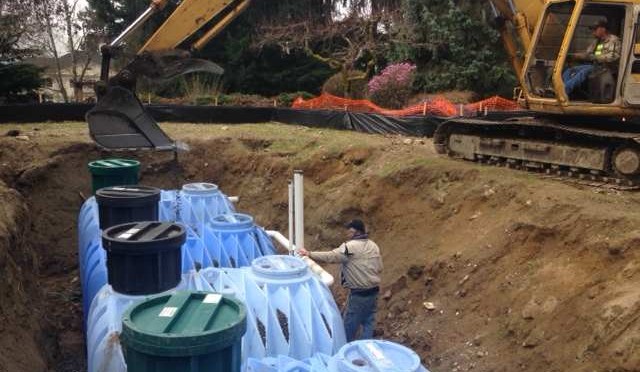
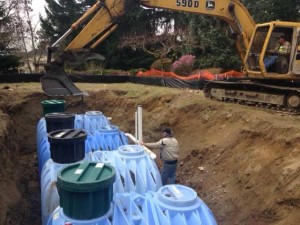 7,200 gallons of collected rainwater for household usage has no visual impact for this newly constructed Bellevue home. The homeowner wanted to have a rainwater catchment system to provide water for the toilet and laundry facility, but he did not want large, above ground water tanks interfering with the landscaping of his backyard.
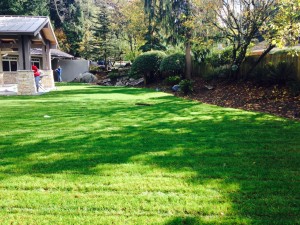 The solution: excavating the old cement swimming pool and placing four 1800 gallon poly water tanks in its place, creating an underground rainwater collection system. All the tanks are connected with a manifold for equalization and supply a pressure tank and filtration in the mechanical room for usage. Solenoid valves provide automatic switching from rainwater to city water if the tanks should run low, but will switch back to rainwater when the tanks receive more water from the roof.
 What type of weather pattern can we expect in the Seattle area this winter?