

 Whether it is misconception, myth, or outdated information, there is a lot of false information out there about rainwater collection. Here isa short list of the most common.
MYTH: It is illegal to collect rainwater for usage.
Many states have revisited water rights laws and have or are passing legislation concerning RWC.
New York, Virginia, Florida, Rhode Island, North Carolina, US Virgin Islands, Ohio, Illinois, Texas, Oklahoma, Colorado, Arizona, New Mexico, Utah, California, Oregon and Washingtonhave all passed some type of legislation legalizing rainwater collection. In many it is up to the county whether collection for potable use is allowed. Check with your county building department.
MYTH: Rainwater collection is new idea.
Rainwater collection dates back as far as 2600 BC in India. Many cultures have harvested rain for usage since then.
MYTH: Rainwater systems are expensive and hard to maintain.
Depending on the design, a potable rainwater system can be approximately the same cost as a well. Maintenance of a well-designed system requires very little maintenance. Hire only those who have experience in designing and installing RWC systems to ensure a system that operates properly.
MYTH: Rainwater is dirty and should not be used for potable demand.
Rainwater is relatively clean compared to surface water. It has not come into contact with contaminants before storage other than the roof. Proper design and installation of storage, conveyance, filtration and disinfection results in exceptional water quality.
MYTH: Rainwater collection can’t possibly provide enough water for my usage.
For every 1,000 sq. ft. of collection area, per inch of rain, 623 gallons are available for collection. A 2,000 sq. ft. home can collect over 44,000 gallons annually.
MYTH: Aquifers and streams will not be recharged if rainwater collection is allowed.
Rooftop collection and use enhances recharge of aquifers and streams due to infiltration. Rather than evaporating, the collected rainwater is used and then infiltrated into the ground through the septic system, and as a result, percolating back down into the aquifer or in stream for future use.
MYTH: Water is infinite, so what’s the big deal?
The natural cycle of water is constantly changing from ocean to atmosphere, to rivers, lakes and aquifers. It is best explained by an article fromOur Blue Planetat Infinite Water
To understand more about rainwater harvesting visitwww.arcsa.org/ www.rainbank.info
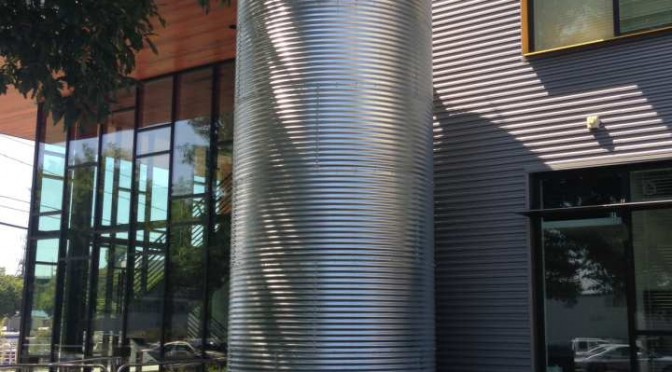
 Many new commercial construction projects are implementing stormwater management into their architectural designs, rather than simply meeting new regulations. Building designers and owners are showcasing their commitment to conservation, and incorporating functionality with aesthetics, in turn, this practicefurthers customer and general public interest in conservation and rainwater collection, creating even more public awareness of the need for conservation and sustainable living practices.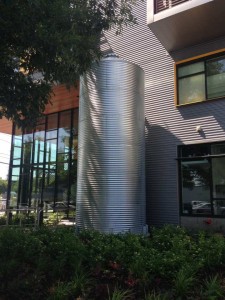

 A Florida nonprofit organization has constructed and enacted a sustainable plan to capture rainwater for reuse in irrigation. In the true spirit of “it takes a village”, the