Category Archives: Commercial Rainwater Harvesting

RainBank to Share Expertise at Rainwater Collection Conference

RainBank to Share Expertise at Rainwater Collection Conference
By Flickr user: Anne Hornyak Chicago, Illinois http://www.annehornyak.com [CC-BY-SA-2.0], via Wikimedia Commons
“Seattle is a progressive city where rainwater collection is becoming mainstream – whether it be small residential supplementary systems or large scale commercial systems. All have a positive impact on storm water management and I am proud to be a part of the process. I would like to thank all my customers, past, present, and future for their commitment to helping our region’s environment.”, Ken Blair, president, RainBank Rainwater Collection Systems.

June 29, 2014 – Seattle, WA. RainBank Rainwater Collection Systems’ president Ken Blair has been invited to be a guest speaker at the American Rainwater Catchment Systems Association 2014 annual conference in Phoenix, Arizona on November 17th. Ken is honored to be recognized among his peers as a leader in rainwater collection and storm water management.

Ken will  discuss “urban rainwater case studies”, an in depth look at decentralized water systems for commercial and residential application in the Seattle area. Both potable and non potable systems designed and constructed by RainBank Rainwater Collection Systems will be highlighted, with emphasis on reduction of storm water run off.

The time is now for Seattle to be recognized as a leader in Green Storm Water Infrastructure. Protecting our natural environment from the pollutants from storm water run off is essential for our way if life in the Pacific North West.

 

Rainwater Collection a Reliable Water Supply Alternative


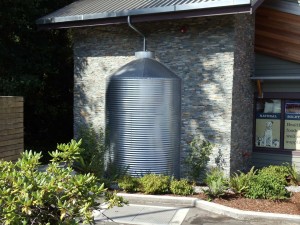
A metal silo against a stone wall with greenery around.According to a recent article published byARCSA(American Rainwater Catchment Systems Association), whose mission is to promote sustainable rainwater collectionpractices to help solve potable, non-potable, stormwater and energy challenges throughout the world, a well-designed, installed and maintained rainwater harvesting system can provide high-quality water for potable and non-potable, residential and commercial uses.
Below are some notable findings on rainwater collection compiled by ARCSA from the 2013 Report Card on America’s Infrastructure from the American Society of Civil Engineers, the U.S. Chamber of Commerce and the National Association of Water Companies:

“¢ 7 TRILLION gallons per day are wasted due to 240,000 water main breaks each year
“¢ Over $1 TRILLION is needed over 10 years to repair water systems

ARCSA is the premier national educational and technical rainwater harvesting organization. Decentralized onsite rain and stormwater harvesting systems can deliver a partial solution to our aging water delivery infrastructure and support new job creation.

To learn more about how individuals and businesses can protect their water supply from disruptions by supplementing utility water with rainwater harvesting, click here to read the entire ARCSA article.

Rainwater Collection in an Urban Setting


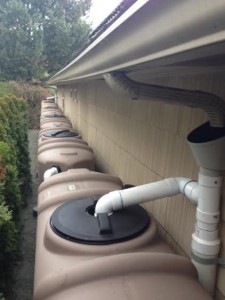
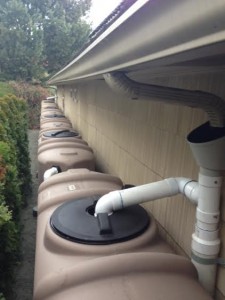
Row of rain barrels connected to a gutter system for water collection.Rainwater collection is becoming increasingly popular for commercial andresidential consumers in urban settings, driven largely by centralized waterunable to meet demands caused by droughts, increased population, along with supplyand demand.

Quality of water is threatened by an aging infrastructure and environmentalconcerns such as the chemical spill in West Virginia last winter. Awareness and concerns of fluorides and chlorine in municipal water supplies areadding to the interest of alternate solutions.

Increased costs to meet storm water management and GSI (green storm waterinfrastructure ) requirements for new construction of commercial andresidential projects are driving owners, designers, engineers, and architects to offset some of the costs involved with implementation.

In a recent report by “the National Resources Defense Council” eight citieswere studied for potential economic impact of rainwater collection. It is estimated the residents of these cities could save 90 million dollars eachyear by adopting simple rainwater harvesting techniques.

Water closet and laundry facilities using rainwater collection are nowbecoming integrated into designs for both commercial and residential application. According to the American Water Works Association,water closetsaccount for approximately 51% of water usage in commercial buildings and approximately 50 % water usage for water closet and laundry facilities inresidential applications.