Tag Archives: featured

How to Save Money with Seattle Area Rainfall


Close-up of a worn, metallic fountain pen nib on a black surface.What could you have done with last weekend’s Seattle area rainfall of around 2.5″?

If your house has 2,000 sq. ft. of roof, you could have collected about 3,000 gallons of water. That could flush toilets for a four person household for 100 days or do over 100 loads of laundry. You could supply both demands in this household for a entire year with as little as 4,000 gallons of storage with our average annual rainfall. The average demand for both of these fixtures is 48% of your household usage. That’s 48% of your water not needed to be distributed through a centralized water system. That’s 48% of you water bill, which is expected to increase consistent with demands, repairs of infrastructure, and availability.

Rainwater collection can be part of your requirements of the new 2016 stormwater code. Our modal above mitigates over 65% of its roof runoff. With larger storage and other use, as much as 100% mitigation can be met. On site infiltration or rain gardens can also augment the drainage plan along with rainwater collection.

RainBank Rainwater Systems is a full service Design / Build, Rainwater Collection Contractor with more than15 years in the industry. We are an American Rainwater Catchment Systems Association (ARCSA) lifetime member and are ARCSA Accredited Professionals. We offer sustainable, scaled deigns, realistic solutions, and quality construction, using only the best suited and tested components on the market. We work closely with our customers and their architects, engineers, and general contractors to achieve the desired end results. Our team has anin house engineer and licensed plumber in order to keep things simple during design and construction, we also take care of the permitting for you.

Contact RainBank Rainwater Systems, we would be pleased to talk with you about your project.

Seattle Stormwater Management and Rainwater Collection


Seattle skyline with Space Needle and Mount Rainier in the background.

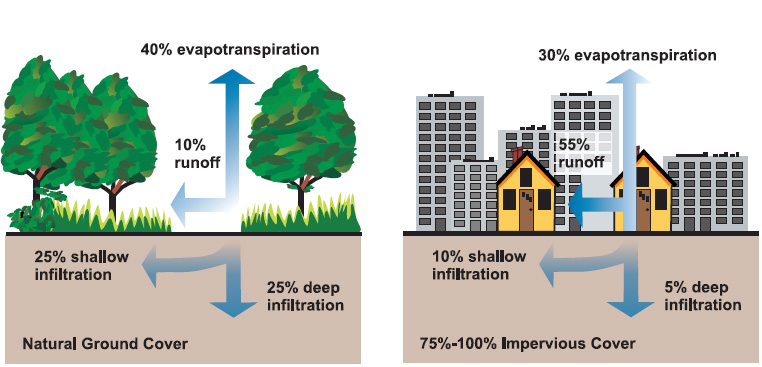
The EPA defines Stormwater as water that originates during precipitation events and snow/ice melt. Without proper management, stormwater can soak into the soil (infiltrate), be held on the surface and evaporate, or runoff and end up in nearby streams, rivers, or other water bodies (surface water). In natural landscapes such as forests, the soil absorbs much of the stormwater and plants help hold stormwater close to where it falls. In developed environments, unmanaged stormwater can create two major issues: one related to the volume and timing of runoff water (flooding) and the other related to potential contaminants that the water is carrying (water pollution).

Close-up of a worn, metallic fountain pen nib on a black surface.

Seattle 2016 stormwater regulations protect people, property, and the environment from damage caused by stormwater runoff. Our stormwater codes also satisfy the City’s obligation to comply with our Municipal Stormwater Discharge National Pollutant Discharge Elimination System (NPDES) Permit, issued by the Washington State Department of Ecology.

The practice of rainwater collection is recognized as an integral part of storm water management as defined by Seattle public Utilities.

Green Stormwater Infrastructure (GSI) includes stormwater best management practices (BMPs) designed to reduce runoff from development using infiltration, evapotranspiration, and/or stormwater reuse. To be considered Green Stormwater Infrastructure, it must provide a function in addition to stormwater management such as water reuse, providing greenspace and/or habitat in the city. Examples of green stormwater infrastructure include trees, bioretention facilities, rain gardens, permeable pavement, vegetated roofs, and rainwater harvesting.

In the stormwater code, all Green Stormwater Infrastructure are considered on-site Stormwater Management BMPs and can be used to comply with the on-site Stormwater Management Requirement, Minimum Requirements for Flow Control, Minimum Requirements for Treatment, or all three, depending on how they are designed and constructed. All projects are required to implement On-site Stormwater Management BMPs to the maximum extent feasible for flow control and water quality treatment. This means that On-site Stormwater Management BMPs must be incorporated throughout the project site wherever feasible, constrained only by the physical limitations of the site and practical considerations of engineering design and necessary business practices.

For more information, visit:

https://www.epa.gov/npdes/npdes-stormwater-program


http://www.seattle.gov/dpd/codesrules/codes/stormwater/


http://www.seattle.gov/util/EnvironmentConservation/Projects/GreenStormwaterInfrastructure/StormwaterCode/index.htm


Why is Rainwater Collection for You?


Close-up of a worn, metallic fountain pen nib on a black surface.Surging population in the Seattle and Puget Sound areas, along with changing regulations fuelsincreased infrastructure demands on municipal water sources. Costs to repair, upgrade, and expand these centralized systems in order to meet these demands will become more of a challenge. The question to be answered is:Why is rainwater collection for you? Originally posted under the title 3 Reasons Why Everyone Benefits from Rainwater Collection, this post will give you insight as to why rainwater collection is for you…

Conserves water:

Rainwater can be collected as a supplementary source or as an alternative to a centralized source. Whether collected rainwater is used for irrigation or potable use, the water savings can be significant for the individual and the community. Over 70 percent of household usage is for irrigation of landscaping, toilet flushing and laundry facility. Depending on collection area and rainfall, whole house demands can be met.

Reduces stormwater runoff:

Stormwater is a concern environmentally as well as economically. The average 2,500 square foot roof in Seattle will yield over 56,000 gallons annually to runoff unless captured and used or infiltrated. Captured rainwater can be used, and then infiltrated passively, rather than carrying contaminants to our lakes, streams, and bodies of water.

Conserves energy:

Any water from a decentralized water system is not processed through a municipal water district where all water is processed to drinking water standards – no matter what its end use will be – such as use in landscaping. Even though a homeowner buys their water for pennies on the gallon, treating water costs a lot of money to process. Most of the costs are absorbed through large users such as manufacturing and farming, however less water being treated at the water districts equals less energy needed for processing and conveyance.

Contact us using the form below to ask how YOU can benefit from rainwater collection at your home or business.

Go back

Your message has been sent

Warning
Warning
Warning
Warning
Warning

Warning.