
Commercial Rainwater Harvesting: Niche to Mainstream


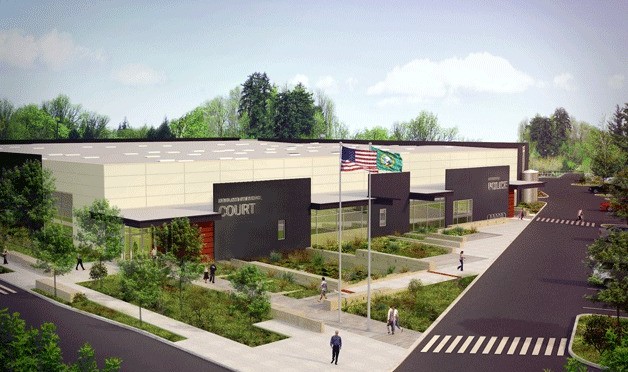
Modern commercial building with greenery and pedestrian pathways.It’s hard to believe that it’s been two years since we completed the project outlined below. We are thrilled to say that interest in rainwater collection has skyrocketed, bringing it from niche to mainstream. Here’s a throwback Thursday post outlining what happened in May, 2014:

RainBank Rainwater Collection Systems is pleased to announce completion of two 5,300-gallon rainwater collection tanks for the new Kirkland Public Safety Building. Both tanks will collectwater from a segment of the building’s roof and divertto irrigation for new plantings. The Safety building was a former Costco building remodeled for the city of Kirkland to be usedasthe new courthouse, police station and jail.

New landscaping will be wateredautomatically by the rain tanks via a computerized controller which will regulate how long and what times watering will take place. With 10,600 gallons of storage and a roof collection area of approximately 20,000 sq. ft., even a small amount of rain in the summer should supply the new plantings with rainwater.
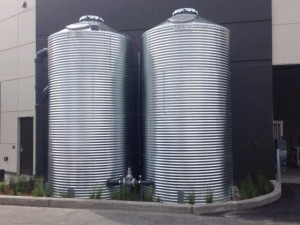
Two large metallic grain silos standing side by side.Infiltration ofthe soil during watering will reduce the building’s stormwater runoff and save money by not using city water.

RainBank Rainwater Collection Systems is proud to be part of this and other commercial projects making the Seattle area a better place to live.

RainBank Systems are built with the highest quality components and installed by our trained staff. Don’t forget to ask us about our steel water tanks – and the industry unmatched 20-year warranty.

We will continue to highlight and share our projects and information with you. We look forward to installing your system in the near future.

This article was originally published under the title Rainwater Harvesting Cuts Costs & Reduces Stormwater Runoff at RainBank.info
Is Rainwater Clean and Safe to Drink?


A clear glass of water placed upside down on a countertop.Rainwater is generally considered clean to begin with, however, water is an excellent medium for growth and transport of disease causing organisms.

The good news is rainwater is relatively easy to filter and disinfect, and disinfected rainwater may significantly improve drinking water supplies.

The clean water act of 1974 and recent amendments have enhanced the protection of drinking water. But, news bulletins throughout the United States of contaminated municipal supplies have spawned an increased interest in rainwater harvesting as a source of drinking water. People are looking toward alternatives to an aging, overwhelmed infrastructure to provide a safe, clean source of drinking water for the household and family.

Water quality problems associated with rainwater harvesting systems most often originate in the catchment area, conveyance system, or storage components caused by:

  • System was poorly maintained
  • Collected water was not properly disinfected
  • Conveyance and storage were poorly designed
  • Simple measures were not taken toensure the quality of the water

All harvested rainwater that is intended for potable use must be treated effectively to minimize the risk of harming human health. To ensure a RWH system is producing high quality water, proper techniques in design, construction and maintenance along with testing need to be conducted.

Recent plumbing codes set by the American National Standards Institute (ANSI) and American Society of Plumbing Engineers (ASPE) along with the American Rainwater Catchment Systems Association (ARCSA) have been adopted at the national level and must be adhered to by designers and contractors installing rainwater collection systems meant for potable and non potable use.

Rainwater harvesting can be a safe, reliable source of drinking water if codes and practices are conducted. Ask if your designer and installer are ARCSA Accredited Professionals and are up to date on the latest plumbing codes.

Cost vs. the Value of Water


Close-up of a worn, metallic fountain pen nib on a black surface.Humans cannot survive without water. But, how much should water cost?

Below is a throwback Thursday post about the cost of Seattle water:

The Seattle water system is a good one,provided by Seattle Public Utilities. But, as the demand grows with urban development and population, the cost of Seattle water will need to rise to support expansion.

A recentarticleby Gene Balk in the Seattle Times makes some interesting points. Balk mentions“…bafflingly – drought-stricken Fresno, Calif., has some of the cheapest water in the nation. At a 50-gallon-per-person usage, a family of four would pay just $41.63 – less than one-quarter of the cost in soggy Seattle.”

Balk goes on to write:“Seattle has such high rates because we’ve invested more than most places in our water infrastructure in recent years. We relocated our reservoirs underground, in compliance with federal mandates, to keep our drinking water safe from contaminants. “

We can clearly see that it’s not theamountof Seattle water that is the generator of costs, it is theinfrastructurerequired to convey and treat the water to potable standards.

Approximately 70% of household water demandis for non-potable usage. Irrigation, water closets, laundry, and wash down account for this non potable use. Rainwater collection can mitigate non potable use of city water and have a positive effect on our centralized water system and environment.

The commercial building owner and the home owner can enjoy healthysavings on future Seattle water bills by utilizing rainwater collection. Stormwater reduction could be significantly recognized through on site filtration if buildings and homes in the urban environment adopted rainwater collection.

Seattle is a progressive city in many ways and rainwater collection is part of that progression.

This article was originally published under the title The Cost of Seattle Waterat RainBank.info

Rainwater Systems