All posts by Ken Blair

A rainwater collection systems designer and consultant, Ken has designed and installed residential and commercial systems, primarily in the northwest United States for more than 10 years and, in 2014, began consulting and managing builds in other states. Ken is an accredited ARCSA Professional Designer / Installer and Life Member, the Northwest Regional ARCSA representative and advisor to its education committee and is available to speak about Rainwater Collection Systems design and builds. Ken is a United States Navy veteran, having served on active duty during the Vietnam War era. A career entrepreneur, Ken created a new business focus with a commercial dive company in Hawaii in the mid 1980′s to respond to and clean up oil spills, oil spill equipment training, service and maintenance for the oil co-op service industry. Ken is passionate about having a positive impact on the environment and is also a founding director of BANK-ON-RAIN (2011-2014), whose mission is to create grassroots solutions for rainwater collection for consumption and agriculture in developing areas of the planet.

Making Smart Choices About Water Use


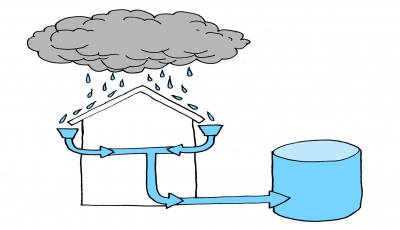
Diagram showing rainwater collection from a roof into a storage tank.

Rainwater collection is growing inpopularity in the United States, including here in the Seattle area. Many commercial and residential new construction projects are discovering that rainwater collection can save costs on complying withthe mandated GSI (greenstorm waterinfrastructure) of infiltration on site while saving water use and energy at the same time.

Treatingwater for potable standards is not energyefficient formunicipal water districts. Even though water is cheap for the consumer, it doesrequire high costs to maintain this levelof quality to potable standards. Thereason the costs are low to the consumer is because of the large amounts of water being sold to manufacturing and farming. On a large scale, reducing the energy needed by using untreated water for toilet flushing and laundry facilities could reduce the costs of water from these water districts. Imagine the reduction of energy saved if all commercial new construction implemented RWC for this use only.
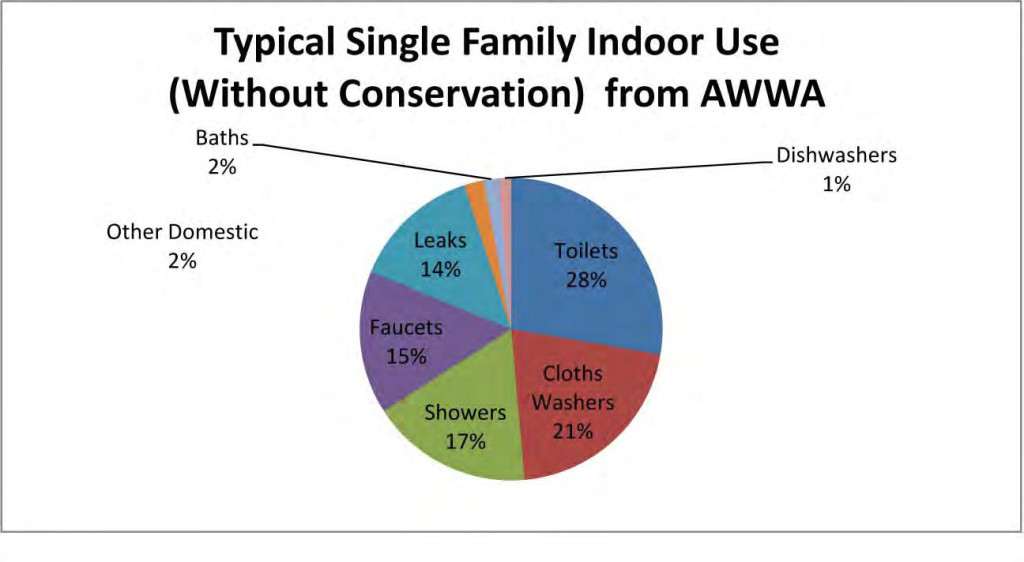
Pie chart of indoor water use in typical single-family homes without conservation.Based on thischart from the American Water Works Association (AWWA) toilets make up28% of residential water consumption without conservation and laundry 21%. The use of highefficiency toilets, washing machines and low flow devices will reduce the amounts even more. A simple rainwater collection system for toilet and laundry will reduce household demand ofmunicipal water by 49%. Imagine the savings on a larger scale forenergy,storm water runoff, depletion of ouraquifers, and demands on a centralized water system.

Every drop of water is important and we can make smart choices about where every drop goes.
Arts and Science Academy To Use RWC System for Toilet Flushing


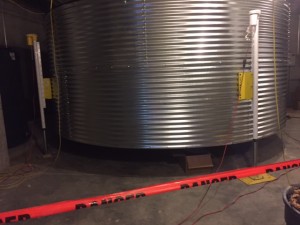
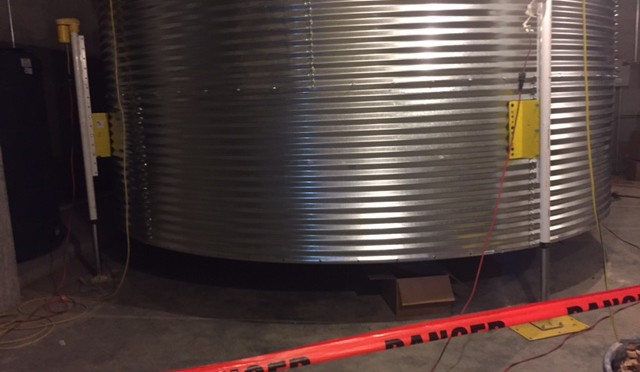
Large metal tank with caution tape around it in an industrial setting.

RainBank Rainwater Systems is constructing a 11,000 gallon flat roof CorGal tank for the Seattle Arts and Science Academy on Capital Hill in Seattle.

The collected rainwater will be used for toilet flushing throughout the school.

The challenge for RainBank was to construct the 10 foot tall tank in the basement of the building with very little head clearance.

Electric bin jacks were used to lift the first two upper levels and roof assembly to place the bottom panels in place.

Seattle Arts and Science Academy joins many newly constructed commercial buildings using rainwater collection to help mitigate storm water run off.

Here’s a short video clip of the build:

Skagit County’s First Residential Building Permit With RWC as Sole Source of Water


A peaceful river flowing through a green valley with distant mountains.Skagit County Planning Department issues its first residential building permit with rainwater collection as sole source of water.

Property owners affected by the in stream flow rulein the Skagit Valley river basin now have a viable solution for residential development of their properties.

Last week, Skagit County Health Department issued a “water availability” based on rainwater collection, allowing construction of a single family residence using rainwater as thesole source of water.

The system design collects rainwater from the roof, which is pre-screened and conveyed to 10,000 gallons of storage adjacent to the house. The water is pressurized, then filtrated using sediment and carbon filters and disinfected by ultraviolet light forwhole house, potable use. With an average annual rainfall of 33.2 ” and 3,500 sq. ft. of roof, 72,392 gallons are available for collection. After household use. the water is returned to the soil through the septic system and leach field just like a well system with no ill effects on the in stream flow rates.

Simple, routine maintenance conducted by the homeowner will supplythis 3 bedroom, five occupant home with a safe, reliable, clean source of potable water while benefitting “in stream flow” and salmon habitat.

Skagit River Looking East