ARCSA Professional Development for Rainwater Harvesting Professionals – February 2015


Two rows of colorful pencils arranged in a semi-circle on a white background.RainBank isARCSA’sNorthwest Regional Representative and will share and promote ARCSA’s mission to promote sustainable rainwater harvesting practices to help solve potable, non-potable, stormwater and energy challenges throughout the world.

Here are some upcoming ARCSA education opportunities that would benefit rainwater harvestingindustry professionals at varying levels of professional development. Subscribe to RainBank’s blog (check box below) to receive more notifications, or subscribe directly toARCSA’s newsletter.

  • Urban Soil Water Summit
    2/24/2015 » 2/25/2015
    Location:Los Angeles, CaliforniaTime:7:30 am pst to 7:30 pm pst This is a member only event, please click for more info about ARCSA membership

“Color Pencils Isolated On White Background” courtesy of cbenjasuwan / www.freedigitalphotos.net
Resilience in Green Building: Seattle Area Educational Meeting


Lush green hills with mist-covered mountains in the background under a cloudy sky.If you want to learn more about rainwater collection in the Seattle area from an American Rainwater Catchment Association (ARCSA) Accredited Professional, join Ken Blair, president of RainBank Rainwater Systems and the Northwest EcoBuilding Guild for an educational meeting, Resilience in Green Building, on Wednesday, January 28th at the Phinney Neighborhood Center from 6:30 – 9:00 pm PT.
Ken has been a leader in rainwater collection since 2005 and is a lifetime member of ARCSA, an ARCSA Accredited Professional, ARCSA’s NW Regional Representative, advisor to the ARCSA education committee, guest speaker at the 2011 & 2014 ARCSA conference, as well as the founder of RainBank Rainwater Systems and co-founder of Bank on Rain, a non-profit organization bringing grass root solutions for clean drinking water to remote villages in Africa.

TheNorthwest EcoBuilding Guildis a 501(c)(3) community of builders, designers, suppliers, homeowners, and partners concerned with ecological building in the Pacific Northwest.The Guild empowers people through education to transform the built environment for long term sustainability. The guild’s mission is to support through education, the progressive work of its members in the Pacific Northwest in order to improve the relationship between communities and the built environment.

Founded in 1993 by a small group of professionals already incorporating green building ideas into their practices, the Guild was formed in order to network, learn and exchange ideas related to specific areas of expertise. The Guild has seven chapters serving the diverse bioregions of Washington, Oregon, Idaho and British Columbia. It provides open-source educational materials to the construction industry and the general public in order to encourage building practices that dramatically reduce carbon emissions, are self-sustaining, contribute to local economies, and create optimal conditions for human health and community.

Within the Guild community there is a strong emphasis on thought-leadership, community, integrity, sustainability, innovation, education and fun. These values are the foundation for all Guild programs, and are carried forward by the Guild Chapters and members alike.

The event is free for Guild members; a $10 donation is suggested for non-members. Space is limited so please RSVP. For more information about the program on January 28th, or to make a reservation, please click here.

“A Storm In The Mountains” courtesy of Christian Meyn / www.freedigitalphotos.net

Buried Tanks Offer Zero Visual Impact


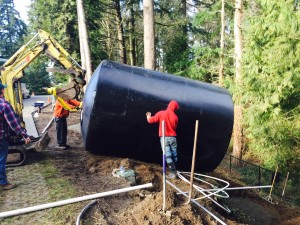
Workers install a large black tank in a forested area.How do you install tanks with no visual impact?
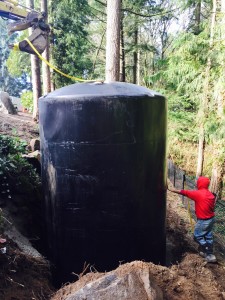
With more thanten years of experience in rainwater collection system designs and tank installs, RainBank loves a good challenge. The issueat hand was to have the storage systems leave no visual impact for a residence with broad, sweeping landscaping. The solution: buried tanks.

A person in a red jacket stands next to a large black cylindrical tank outdoors.This 5,000 gallon tank needed to be placed on its dug pad 10 feet below the driveway and down an existing rockery. RainBank useda mini excavator to control lowering the tank over the edge and into it’s resting place. With a little landscaping at the top of the rockery, you won’t even see the buried tank.
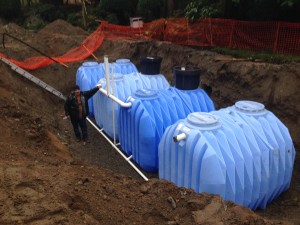
Workers installing large blue septic tanks in a trench.


The rest of the storage for this potable system consists of four – 1,800 gallon buried tanks in the back yard from which an old swimming pool was excavated and the tanks put in its place.

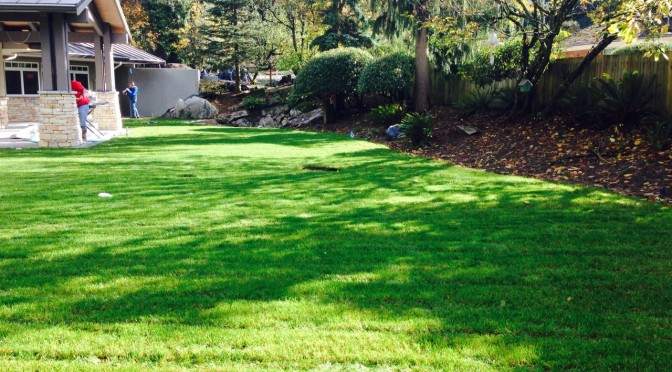
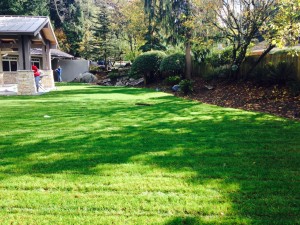
A sunny backyard with lush green grass and surrounding trees.

After the tanks were installed, theywere back filled and the yard was restored to a nice lawn area with no tanks visible.


Rainwater Systems