
While we know one day can’t bring about the change this earth needs in order for us to survive, we can always take steps to preserve our natural resources for current and future generations.
Hopefully, we learn from our past mistakes and, moving forward, adoptnew techniques and develop advances in technology to ensure we (and our children and grandchildren) have enough water and air for their children and grandchildren.
But first, we as individuals have to do our part to ensure we aren’t part of the problem. Take a look atthe Earthday.org blog for enlightening and encouraging stories about folks around the world who are making a difference in their schools, organizations, communities, businesses and countries.
What can you do? Take action.
- Tell our leaders how you feel about climate change
- Track your online energy use
- Calculate your ecological footprint
- Eat less meat
- Eat local
- Stop using unnecessary plastic
- See more ways you can take action at Earthday.org
Earth Day Network’s mission is to broaden and diversify the environmental movement worldwide and to mobilize it as the most effective vehicle to build a healthy, sustainable environment, address climate change, and protect the Earth for future generations.
Don’t forget to conserve water! One way to do that is to collect it and use it for watering plants, washing laundry, showering, toilet flushing – and yes, drinking.
While we know we can’t accomplish it allin one day, we can celebrate Earth in many small ways every day.

 Saving money and helping the environment are two good reasons why many Seattle residents choose to opt out of city water usage. Whether the application is for potable (drinking) or non potable use, like irrigation, supplementary tankswith even a small amount of storage can help drop water bills by as much as 80%.
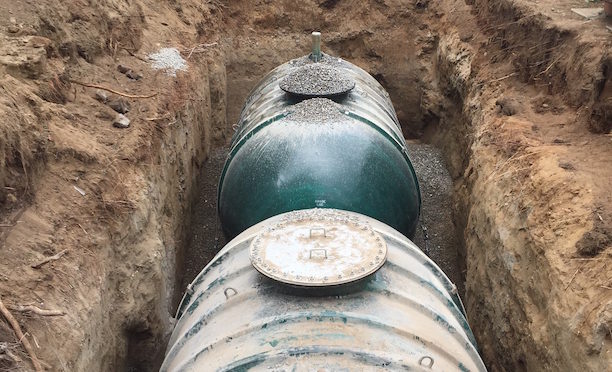
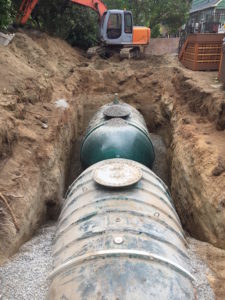 RainBank Rainwater Systems designed and installed a potable rainwater collection system for a remodel in Seattle City limits. The customer wanted to supplement city water usage with “as much storage as possible”, but had very limited space and aesthetics were a main concern. The solution came withtwo 5,000 gallon buried water tanks in the middle of a very small backyard.
 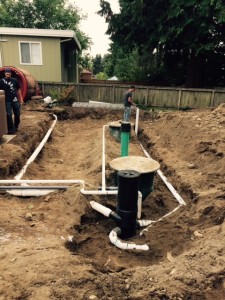 Always appreciatinga challenge, RainBank dug right in with itsawesome excavator, Shane, who managed to export over 120 square yards of soil off site, set the dead men anchors, and nestle the two fiberglass tanks in place with the touch of a feather. The buried tanks were strapped to the dead men (anchoring) and connected together with a 4″ crossover valve. He then backfilled 80% with 5/8″ drain rock while Chad, RainBank’s engineer, took careful deflection readings to be sure the fiberglass tanks were not being distorted during the process.
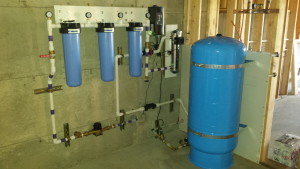 Our plumber, Tracy did a great job of use of space on this project. Using 4’x 20′ canisters with sediment, carbon, and 1 micron sediment for cyst removal, followed by a class “A” UV, the filtration train provides potable whole house demand. The system was designed to be easily maintained so the homeowner can be hisown purveyor of clean, safe, reliable water. With the amount of collection area, annual rainfall and frequency, this two person occupancy should be able to meet 100% of itshousehold use, but also have city water as a backup, just in case.