
 Utilizing the rain that falls on the roof of a building is a simple concept that has provided water to buildings for centuries, and continues as the primary source in many locations in the United States and around the world.
In places such as Bermuda and the US Virgin Islands, the harvesting of rainwater is required by local codes for all new construction. Also, states such as Hawaii andTexas have or are developing design guidelines for rainwater harvestingsystems. Additionally, San Juan County in Washington State has been issuing building permits with rainwater as the sole source of water for several years.
Harvested rainwater is free of most of the pollution typically associated with surface water runoff. Furthermore, usingharvested rainwater both reduces peak storm water discharge velocities associated with impervious surfaces and reduces the draw on aquifers and municipal water supplies. Collected rainwater does not have to be pumped up from a well or be conveyed from a distant central treatment facility. This reduces energy consumption, reduces the use of chemical treatment and disinfection as well as it is less disruptive to the natural hydrologic cycle.
On October 12, 2009 the Washington State Department of Ecology issued an Interpretive Policy Statement clarifying that a water right is no longer required for roof top collection. Since January 25, 2011, King County has adopted rainwater harvesting for potable use in single family residences as a supplemental water source. Other Washington State Counties have since adopted rainwater collection for potable use in single family residence as well.
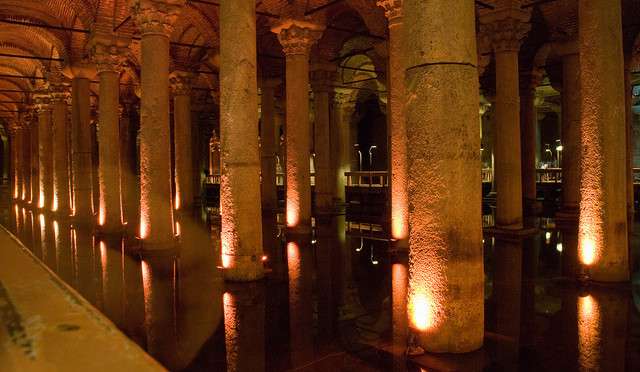
Ancient Istanbul Water System courtesy of David Malloy
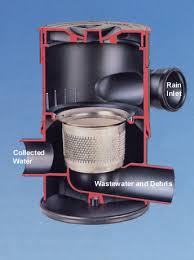 The vortex filter is more of a hands-free device instead of the first flush and for most applications, this designer/installer prefers it. The vortex filter works on a centrifugal theory, where the water enters the top side of the filter from the tight line and is directed into a channeled side which swirls the water horizontally, passing through a screen, then towards storage. Residual water along with the debris falls through the center and towards waste.