
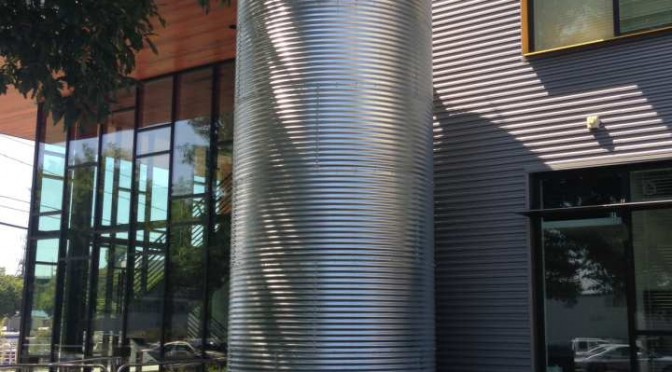
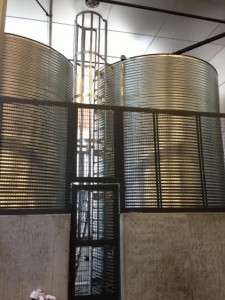
 We recently discussed designing a residentialrainwater collection storagefor irrigation based on capacity and amount of irrigation needed. Now lets look into designing a commercial rainwater collection system for irrigation, based on the same theory.
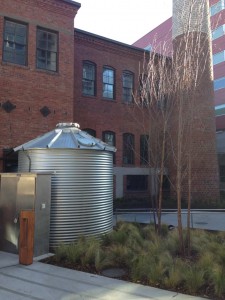 Commercial irrigation demands are significantly higher than residential,requiring much larger storage capacities. Landscaping of a commercial building can be extensive. The use of drought tolerant plants, swales and rain gardensare becomingincreasingly popular. New construction is required to infiltrate or use roof runoff. Rainwater collection can offset costs of expensive infiltration and cut municipal water supply usage.
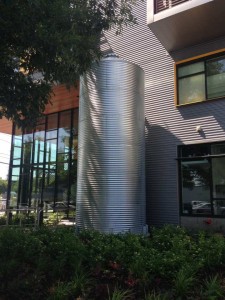 The larger roof area of a typical commercial building will produce a large amount of water. If one square foot of surface area receives .623 gallons of water per 1″of rainfall, a 20,000 square foot roof will yield approximately 12,460gallons per 1″ of rain.If 1″ of rainfall is required for the healthy growth of plants and 1 square foot of surface areareceives .623 gallons per 1″ of rainfall, a 4,000 squarefoot area would require 2,492gallons per week or 29,904gallons stored for the 3 month dry period.
Fromthese equations, you can see that carefulthought to the landscaping will help bring the storage capacitydown. As much as 50% reduction can be achieved by integrating both landscaping design and storage capacities. Generally, steel, bolted together “silo”, style tanks are best suited for commercial applications. Many architects are including these cisterns as focal pointsin their designs,adding a bit of an industrial look. Irrigation of landscaping uses most of its water during the summer months. By incorporating rain gardens or swales into the landscaping,considerable amounts ofwater can be infiltrated during the rainy season while stored waterproviding watering during the summer months.

Ken is a United States Navy veteran, having served on active duty during the Vietnam War era.
A career entrepreneur, Ken created a new business focus with a commercial dive company in Hawaii in the mid 1980′s to respond to and clean up oil spills, oil spill equipment training, service and maintenance for the oil co-op service industry. Ken is passionate about having a positive impact on the environment and is also a founding director of BANK-ON-RAIN (2011-2014), whose mission is to create grassroots solutions for rainwater collection for consumption and agriculture in developing areas of the planet.